Open any case shop in 2026 and you'll find them within a page or two: patterns that are technically beautiful, slightly too smooth, and available in forty colourways at once. Conjured, not drawn.
This is not going to be an article about how AI art is bad. It isn't, and that argument has been made badly enough already.
This is about something narrower and more practical, and it starts with a legal fact most people haven't caught up to.
An image made purely by AI has no author
On March 2, 2026, the United States Supreme Court declined to hear Thaler v. Perlmutter. The case asked whether a work generated autonomously by an AI system could be copyrighted. The Court refused to take it, which left the lower ruling standing: US copyright protects only works with human authorship.
The D.C. Circuit had already put it plainly — the Copyright Act requires that eligible work be "authored in the first instance by a human being," and the Copyright Office "will refuse to register a claim if it determines that a human being did not create the work."
Here's the part that gets left out of most summaries, and it matters for fairness: the same ruling says the rule "requires only that the author of that work be a human being — the person who created, operated, or used artificial intelligence." Work made with AI, under meaningful human direction, can still be protected, and the Copyright Office has registered hundreds of such works. The line isn't "AI bad." The line is about how much of a human is actually in it.
Which brings us to phone cases, because a case is a very public place to print something whose author field is empty.
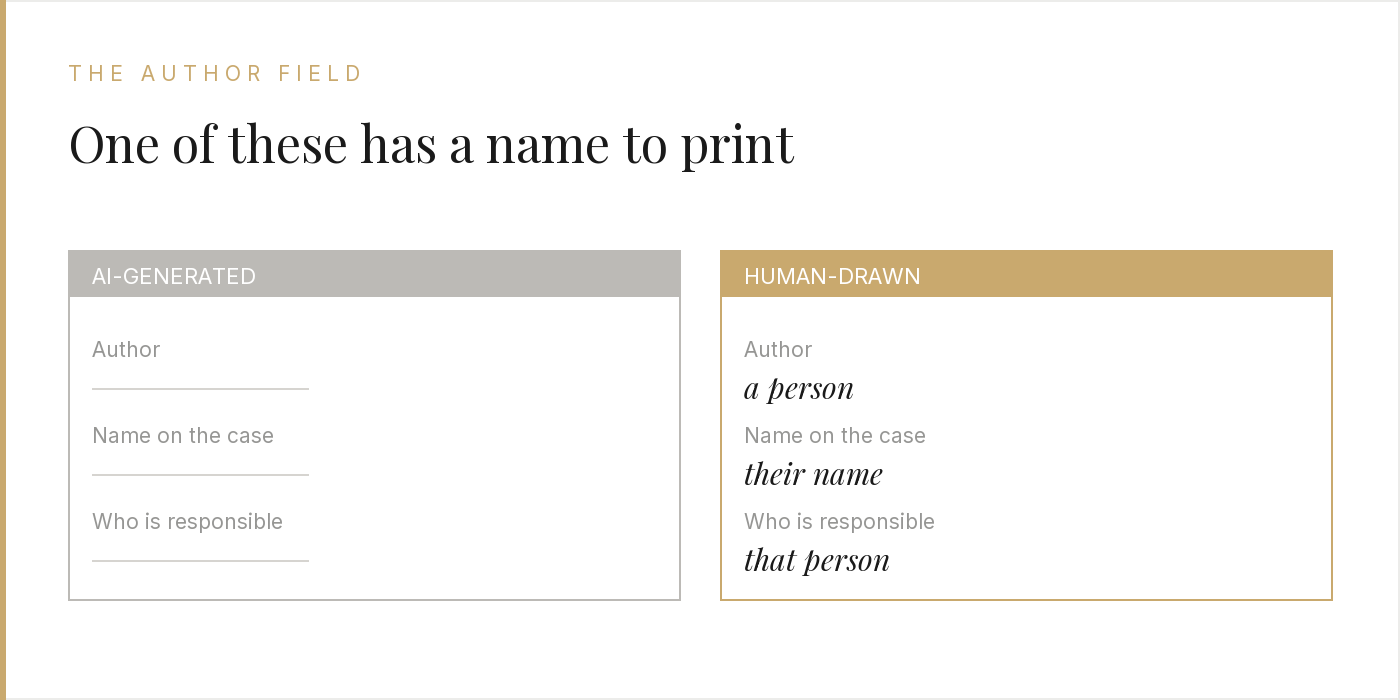
Three things go missing when a design has no author
None of these are moral objections. They're all things you can check.
1. There's nobody to credit. Every case we make carries the name of the person who drew it. That's possible because a person drew it. An AI-generated pattern has no name to print, so the credit either goes to the brand, or to nobody, or to a prompt that someone typed once. When you buy a piece of art, part of what you're buying is knowing who made it. That part isn't available.
2. The chain of responsibility has a gap in it. If a printed design turns out to infringe someone else's work — and this is being actively litigated right now — the question of who is responsible runs into an answer that doesn't exist. You can hold an illustrator accountable. You cannot hold a model accountable, and the person who typed the prompt usually has no idea what the model was trained on. There are live cases on exactly this question, including a major entertainment-company suit against an image-generation provider that is still pending.
3. "Limited edition" stops meaning anything. This one is easy to miss. Everything we make is capped at a fixed run, and the cap is real because the artwork is fixed: piece 1 and piece 200 contain the same drawing. Generate the same prompt twice and you get two different images — so a limit of 200 AI-generated cases isn't a limit on anything. And if one arrives damaged and needs replacing, nobody can send you "the same one," because there was no original to be faithful to.
Put those together and you get a specific, checkable difference. Not better or worse art. A different kind of object.
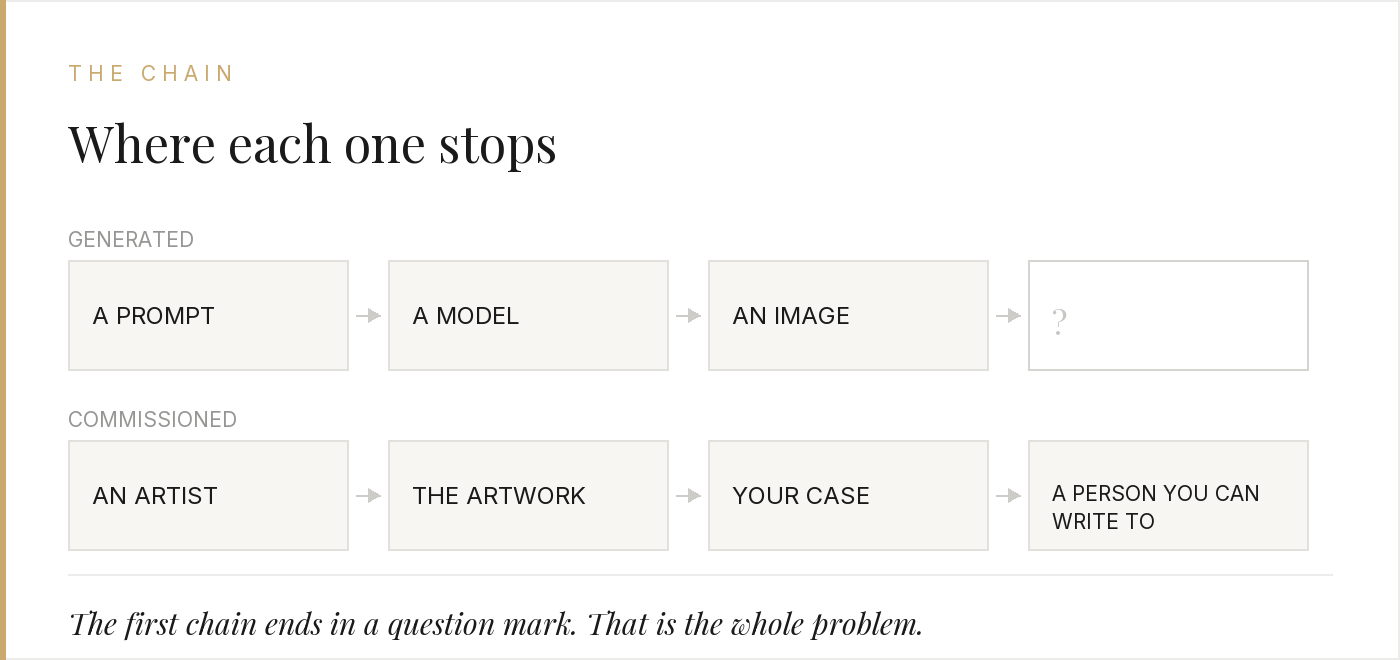
We're not against the tool. We care about who signs.
We use software every day. Rulers, grid paper and colour theory were all once "cheating" too, and no one is romantic about the pre-digital era of anything.
What we care about is narrower: a case gets signed, or it doesn't. A signature is a small thing that carries three large ones — an author, an accountability, and a reason for the thing to exist.
So the position is simple. If a human drew it, we can print their name. If nobody drew it, there's no name to print, and that tells you something about what you're holding.
What that looks like on our side
Every design in our range comes from a named illustrator we commissioned, talked to, and paid. The name is printed on the case. When a design retires, that artist keeps the credit for it — and the ones who want to reach their own audience are linked from the piece.
This isn't generosity. It's the only structure in which the thing we're selling makes sense: art you can carry, from a person you could actually reach. If the artist is a fictional placeholder, then what you bought is a graphic, and graphics don't get credited and paid.
It also means the guarantee can be a real one. Every case carries Silver Guard — a written promise about a physical object that a specific person made. You can't guarantee an image.
If you'd like to see who we work with, they're all in the Gallery with their names on the work. That's the whole point of the page.
How to tell the difference (which is getting harder)
Being honest: this is now genuinely difficult, and it will get harder. The tells of two years ago — melted hands, nonsense detail, symmetrical nothing — are mostly gone.
What still works, in our experience:
- Look for a name, then look up the name. A real illustrator has a body of work elsewhere. One image and no footprint is worth noticing.
- Check whether one designer's pieces look like each other. Humans have habits — the same hand, the same way with a line. Generated images tend to be individually polished and collectively incoherent.
- Check whether the same design exists in thirty unrelated colourways. Infinite variation is a machine's signature, not an artist's decision.
- Ask, if there's a way to ask. A brand that works with real artists is rarely shy about saying so. We put it on the case.
And if you can't tell, that's still information. It means the brand chose not to make it obvious.
One line
A phone case is small, cheap and constantly in your hand. It's a strange thing to care about the authorship of — and yet the whole reason we started was that we wanted to hold something a person had made.
We print the artist's name on the case. Not a prompt. Not a model. A person, who got paid, and who you could write to.
Real value. Real care.
Sources: the Supreme Court's denial of certiorari in Thaler v. Perlmutter on March 2, 2026, leaving standing the D.C. Circuit's holding that the Copyright Act requires human authorship; the US Copyright Office's registration practice on works containing AI-generated material. Copyright questions are unsettled and actively litigated, and nothing here is legal advice. We're stating our own position as a brand, not predicting how a court will rule.