A clear case is the most honest thing you can put on a phone. It adds nothing, hides nothing, and lets the object you paid for stay visible.
Then, somewhere around month three, it stops being clear.
Not dirty — you've cleaned it. Not scratched — you'd see that. It has simply changed colour, from the inside out, into a kind of milky amber that nobody chose. And no amount of soap brings it back, which is the part that makes people angry. They assume they did something wrong.
You didn't. This is chemistry, and it's worth understanding, because the same chemistry explains why some clear cases last a year and others don't last a summer.
Why do clear phone cases turn yellow? Not dirt — oxidation
Almost every clear case on the market is made from TPU — thermoplastic polyurethane. It's flexible, it absorbs impacts, it's cheap to mould, and it wraps around a phone's edges beautifully. It's also the single most yellow-prone material in the category.
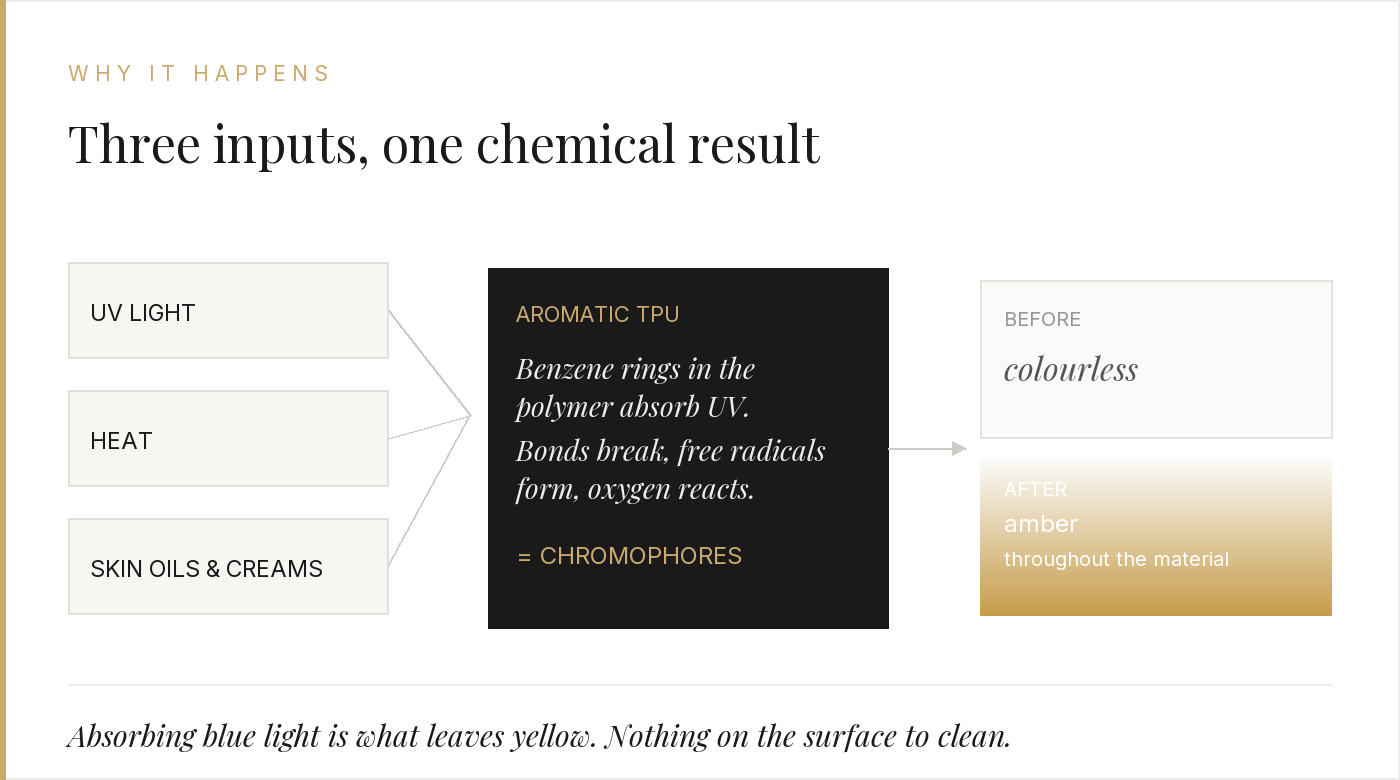
Here's the part that matters. Standard TPU is aromatic TPU, and "aromatic" is a chemistry term, not a smell. It means the polymer chain contains benzene rings — ring-shaped structures that happen to be very good at absorbing ultraviolet light.
Absorbing UV is the problem. The energy breaks bonds in the polymer, which creates free radicals, which react with oxygen in the air. That reaction produces what materials scientists call chromophores — molecules that absorb blue light and let everything else through. Blue removed from white light leaves yellow. That's the whole trick. The case isn't coated in yellow. It has become yellow, at a molecular level, throughout the material.
Which is why it can't be washed off, and why the yellow often appears first at the edges — the thin, flexible parts get the most UV exposure, the most flexing, and the most contact with your hands.
Why some cases yellow in weeks and others take a year
Two clear cases can look identical in the product photo and behave completely differently in your pocket. The difference is almost entirely material and structure.
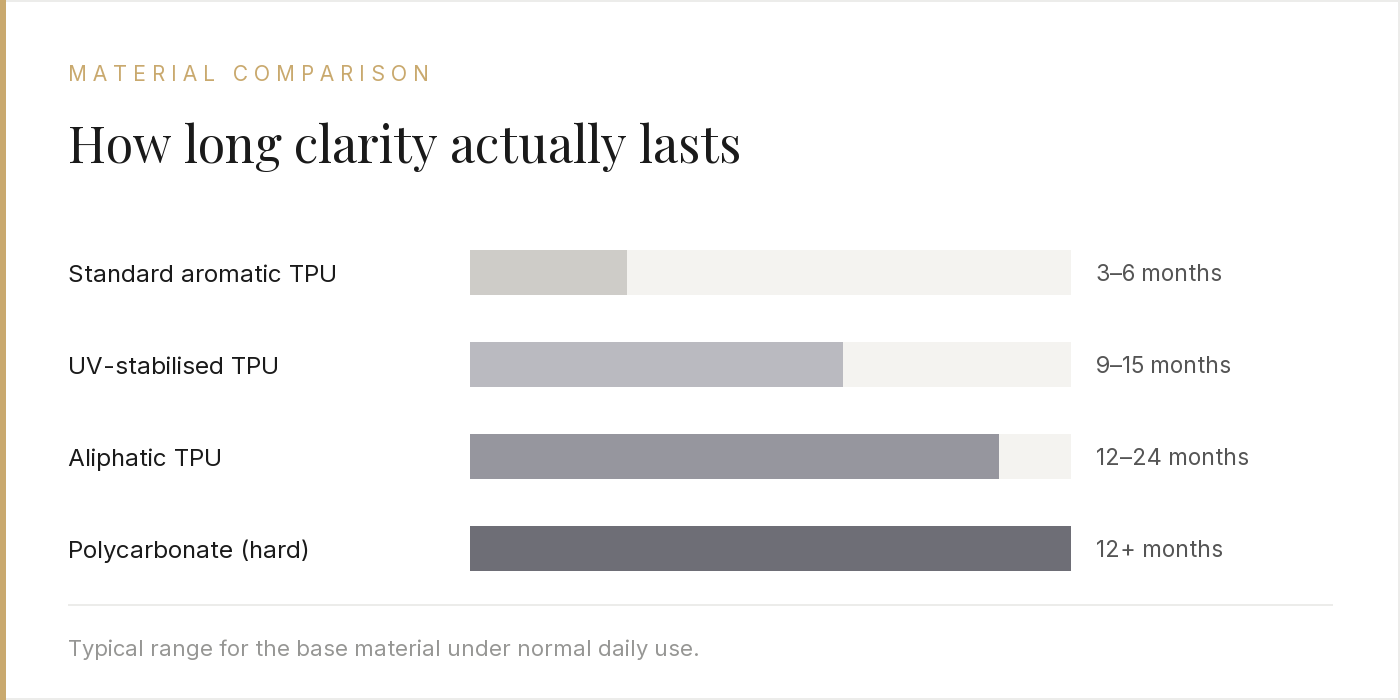
- Standard aromatic TPU — the cheapest and most common. Flexible, protective, and the fastest to discolour. This is the case that turns amber in a season.
- UV-stabilised TPU — the same base polymer with light stabilisers added (HALS and benzotriazole absorbers are the usual ones). These neutralise the free radicals before they can form chromophores. Honestly better, meaningfully more expensive, and usually labelled "anti-yellowing" or "UV-resistant" if the brand is proud of it.
- Aliphatic TPU — the newer, better answer. Same family, but the polymer backbone has no benzene rings, so the UV has far less to grab onto. This is the material premium clear cases have moved to, and it's the closest thing to a real fix that currently exists.
- Polycarbonate (PC) — hard, rigid, and highly resistant to yellowing because its molecular structure is stable under UV. PC doesn't flex, though, and on its own it transmits impact rather than absorbing it.
- Silicone — soft and grippy, and it discolours too, mostly by absorbing oils and residues into its surface rather than through UV breakdown.
This is why so many good clear cases are hybrids: a hard PC back panel for clarity, with a flexible frame around the edges for drop protection. The back stays clear because it's PC. The frame, being soft, is the part that eventually goes amber — which is exactly where you'll notice it first.
Three things you're doing that speed it up
None of these feel like damage. All of them are.
1. Wiping it with alcohol. Hand sanitiser, disinfectant wipes, alcohol sprays — these are solvents, and they attack exactly the surface chemistry that's holding the material together. The same goes for the alcohol in perfume, sunscreen and hand cream, which is part of why the yellowing often shows up first where your hand rests.
2. Leaving it in the sun. A phone on a car dashboard or a sunny windowsill is being UV-irradiated at many times the dose it gets in a pocket. Heat compounds it: faster molecular movement means faster oxidation, and a phone in a hot car gets both at once.
3. Scrubbing it with anything abrasive. Baking soda, whitening toothpaste, "restoring" polishes. These don't remove the yellow — it isn't on the surface — but they do scratch the plastic, and micro-scratches scatter light, which makes the whole case look duller and older even after you've stopped.
The frustrating part is that all three are things people do because they care about the case. The instinct is right. The method isn't.
Once it's yellow, the case has failed at its only job
Worth being precise about what's actually been lost here.
You didn't buy a clear case for protection — a black case protects just as well for less money. You bought it because it shows you the phone. The colour, the metal edge, the thing you chose in the shop.
Once the case goes amber, it no longer shows you the phone. It shows you a fog sitting between you and the phone. The feature you paid for is gone, and what's left behind is a yellowish shell that you now have to explain to yourself every time you take it out of your pocket.
So a clear case isn't really a neutral purchase. It's a bet that a material won't age — and materials age on their own schedule, not yours.
How to pick one that stays clear
Practical, in order of how much difference it makes:
- Check the material, not the photos. Look for "polycarbonate" or "PC" for the back panel, or "aliphatic TPU". If the listing just says "TPU" with no qualifier, assume standard aromatic TPU and plan accordingly.
- Look for a hybrid build. Hard back + flexible frame is the structure that gets you clarity where you see it and protection where you need it.
- Read the one-star reviews, not the five-star ones. Search the review section for the word "yellow". Reviews written after three months will tell you what the product photos never will.
- Ask about UV stabilisers. "Anti-yellowing" and "UV-resistant" are meaningful claims. A brand that has invested here will say so unprompted.
- Skip the alcohol. Warm water, a drop of mild dish soap, a soft cloth. That's the entire maintenance routine.
Where we land on it
Most of what we make is not clear. It's an artist's work printed on a backing, framed by a chrome-silver edge — because the edge is the part of a case that belongs to the phone, and we'd rather give you something to look at than a window with nothing behind it.
When we do build a clear case — it's in our classic range — we build it the way this article says to: a hard polycarbonate back panel rather than a soft TPU frame, because that's the material that stays clear. It costs more to make. It's the reason ours doesn't go amber in a season, and it's the whole reason we agreed to make one at all.
And this is the same argument as everything else we've written. A case that hides its wear, or that's designed to be replaced every few months, is a case that's been optimised for the wrong thing. We'd rather use the material that lasts and then tell you exactly how to keep it that way.
If you want to see what we build instead, it's in the Gallery — and if you're weighing materials against each other, our take on silver edges and how they wear is the honest version.
Real value. Real care.
The short version: yellowing is oxidation, and it starts when UV light breaks bonds in aromatic TPU. It can't be cleaned off because it isn't on the surface. Choose polycarbonate or aliphatic TPU, keep the case out of direct sun and hot cars, clean it with warm water and mild soap, and never use alcohol or abrasives. Questions? hello@musefolk.com is read by a person.