I bought a silver phone, and then spent three evenings looking for a case that wouldn't ruin it.
Not the phone. The phone was fine. It was the search that got under my skin.
I'd open a shop, filter down to cases, and start counting silver frames. Black ones, I stopped counting after the first page. Clear ones, hundreds. Silver? A handful. And when I opened those, the reviews all said the same thing.
Plating started flaking within a few weeks. Three months in, the corners looked scraped.
I remember closing the tab and thinking: is nobody making this properly? It took me another two years to understand that the real answer was worse. Plenty of people know how to make it. They've all decided not to.
This is the story of why we went the other way — and why every case we sell comes with a promise attached.
Silver is the only finish that tells on itself
Start with the part most brands won't say plainly. Silver is the hardest finish in this industry to sell. Not to make. To sell.
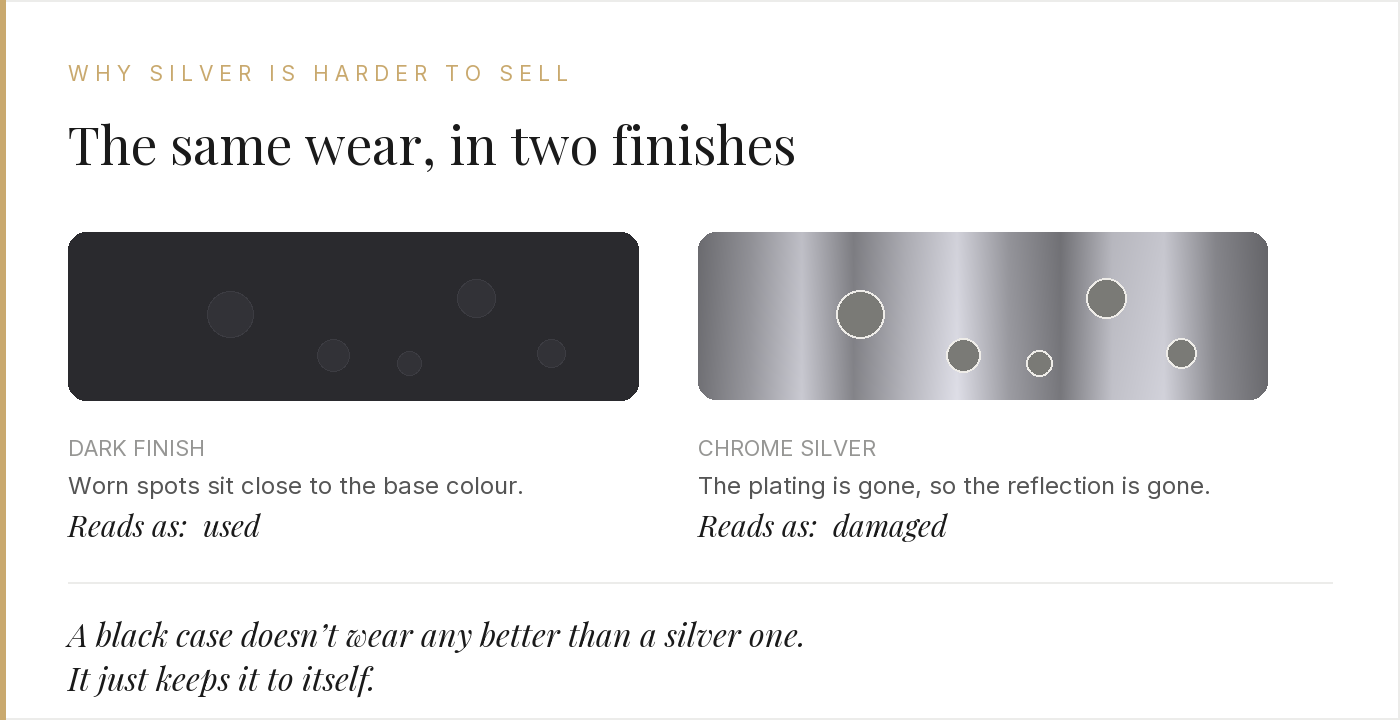
Here's why. On a black case, the colour lives in the material itself — the plastic is dyed through, or the coating is bonded into the surface. Wear it down and what's underneath is usually close to the same tone. A scuffed corner on a black case reads as used. It looks like a scuffed corner. Nobody opens a support ticket about it.
Silver doesn't work that way, because the colour isn't in the material. Silver is a thin film of metal sitting on top of it, and its colour comes from the way that film throws light back at you. Go through the film and what's underneath is nothing like silver. It's matte, dull, closer to pale grey.
Which means a worn silver case doesn't look used. It looks damaged. The gap between the mirror edge and the spot where the plating gave up is impossible to unsee.
A black case doesn't wear any better than a silver one. It just keeps it to itself.
So the arithmetic stacks against silver, and it stacks honestly. More process steps. Tighter quality control. A higher complaint rate than any other finish — not because it fails more often, but because it announces it. If you're running a category on volume and low returns, retiring silver is the sensible call. I don't think that's a conspiracy, and I'm not going to stand here and call those brands villains.
They ran the numbers. I didn't want to run the same ones.
It started with the phone, not the case
Here's the part I've thought about the longest. Why silver at all?
Because the phone already is silver.
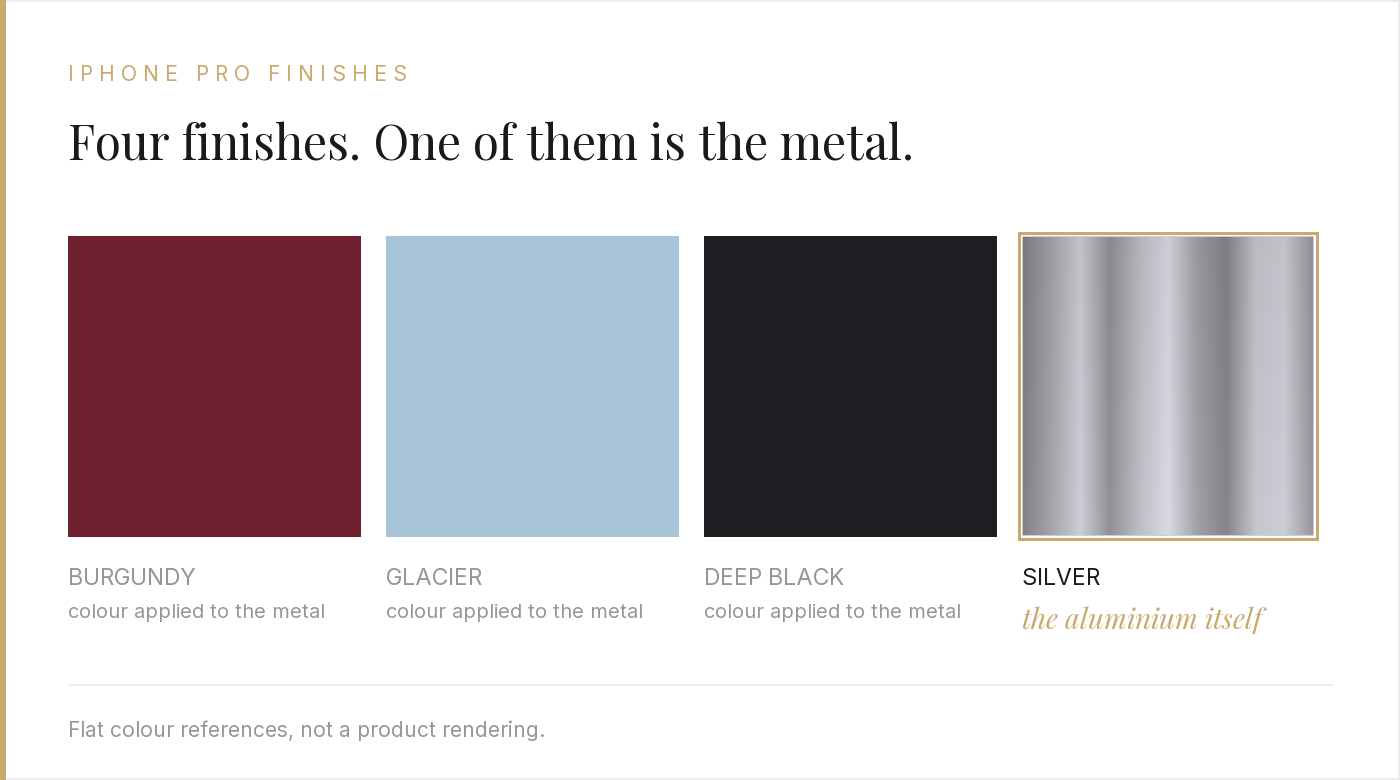
The current iPhone Pro is built around an aluminium frame, and it ships in four finishes: Burgundy, Glacier, Deep Black, and Silver. Three of those are colour applied to the metal. Silver is the metal.
It isn't a coat. It's the absence of one. It's the material left alone.
So when you put a black case on a silver phone, you don't make it more discreet. You give it a border that doesn't belong to it. The phone's own metal edge — the one that catches the light when you turn it over — disappears, and in its place is a seam that could belong to any phone on the shelf.
I'll be honest about the other half of this, because pretending otherwise would make the rest of this post pointless. I use an iPhone, and I'm not bothered when people can tell. That isn't showing off. It's just: I know what I'm holding, and I bought it on purpose.
A silver edge is how a case says the same thing the phone says. Not louder. The same.
But why not no case, or a clear one?
I made myself answer both of these before I decided to build anything, because they're the obvious objections and they deserve real answers.
No case
I tried it. Twice. The second time cost me a screen.
I pick my phone up something like fifty times a day. No case means every one of those is a small bet, and after a while the odds stop being abstract. I'm not a careful person, and I stopped pretending to be one.
Protecting the phone isn't about trusting your hands. It's about admitting what they're actually like.
A clear case
A clear case looks like the honest answer. It adds nothing, hides nothing, lets the phone be the phone.
Two problems with that. The second one is the one that matters.
First, it's the default. It isn't no choice — it's the choice everybody already made, which is a different thing, and a less interesting one.
Second, it doesn't stay clear. The material yellows as it ages; UV, the oil on your hands, and plain air all push it the same direction. A few months in, "clear" has quietly become a milky, yellowed grey. Not amber. Not deliberate. Just old plastic.
And once it's yellow, it has failed at the only job it had. It no longer shows you the phone. It shows you a fog sitting between you and the phone.
Notice what it turned into, too. Not silver. Not back to the phone's own colour. Something nobody would have chosen if it had come out of the box that way. A clear case isn't the neutral option. It's a bet that a material won't age — and materials always collect.
And a printed one?
I have to be careful here, because printed art is our business. We sell artist-designed cases, and that pull is real. A printed case says something, and saying something is worth paying for.
But the price is that the phone disappears underneath it. You spend real money on a piece of machined aluminium and then cover the whole back with a cartoon. You stop seeing the phone. You see the case.
Which leaves the two-option trap the market keeps handing you: a case that hides the phone, or no case at all. Either it's still an iPhone, or it's mine. Almost nothing lets you have both.
The one part of a case that isn't yours
That's the whole idea behind the frame, and it's why our cases look the way they do.
A phone case has two zones: the back panel, and the edge running around it. Most brands treat them as one surface and print straight across both. We don't, and it's deliberate.
The back is yours. That's where the artist's work goes, with a real name credited on it. That's the part you choose.
The edge isn't yours. It never was. It belongs to the phone, and it should look like it. That's why it's a thin chrome line instead of a colour-matched band — so the edge reads as the phone's own metal continuing around the corner, rather than a case talking over it.
Think about how a framed print works. The frame isn't part of the painting and it isn't trying to be. Its whole job is to hold the work up, then get out of the way. And in a gallery, the frame is almost always metal.
Silver isn't a colour we picked for the edge. It's the only edge that doesn't argue with the phone.
Now the part I'd rather not write
Silver wears.
I'm not going to soften that, because if I do, everything above turns into a sales pitch instead of an argument. Plating is a thin metal layer sitting on a substrate, and daily life is abrasive. Keys in a pocket. Desk edges. The zip on a bag. Wear always starts at the corners and the rim, because that's where stress concentrates and where the layer is thinnest.
What a good process buys you: with PVD chrome and proper pre-treatment, the finish holds through roughly eight to fourteen months of normal daily use. What it doesn't buy you is permanence.
Which is why any brand promising a silver case that will never wear is doing one of two things. Either it's hoping you won't check — or the "silver" is matte silver paint. A colour, not a metal layer. That second one is worth understanding, because painted silver isn't a silver edge. It's a grey case, and it stops looking silver the moment the light moves across it.
So we had two things we could do with that fact.
Hide it with black. The wear happens at exactly the same speed. You just don't get told. That would have been the easy decision, and a dishonest one.
Or say it out loud, and take responsibility for the part that was never your fault.
So we put it in writing
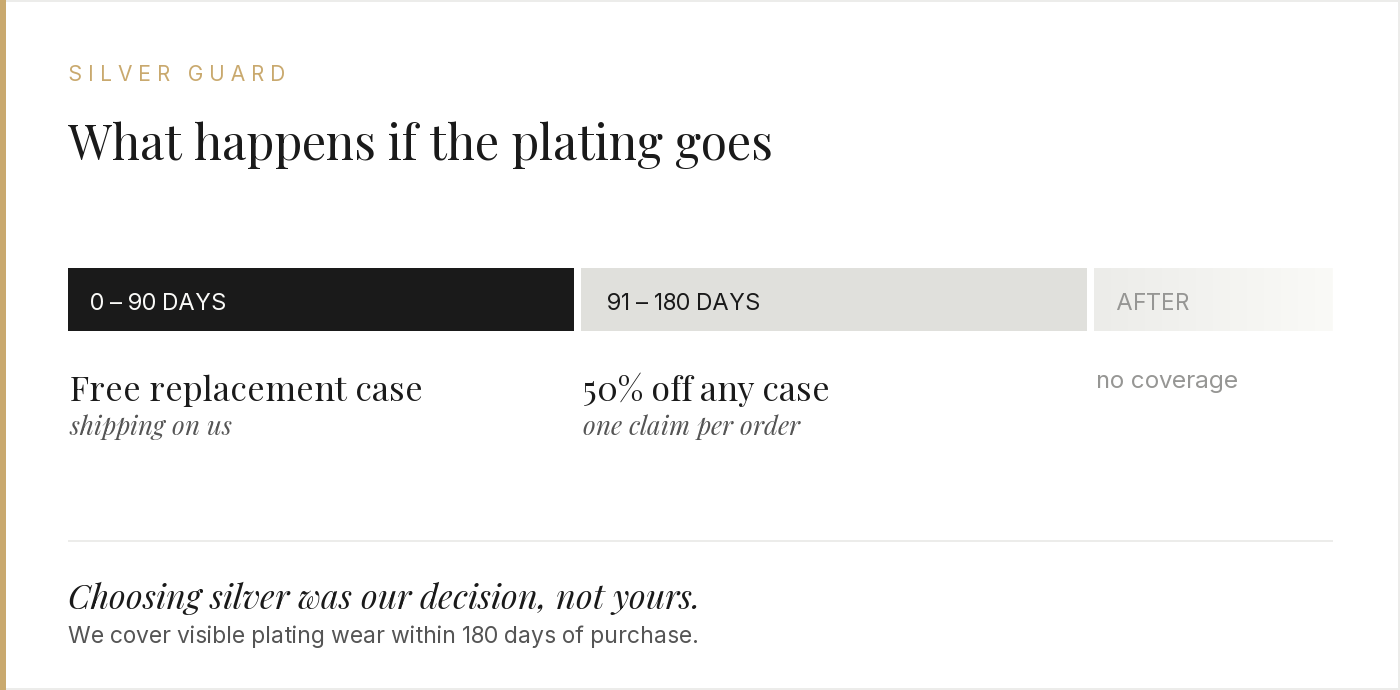
It's called Silver Guard, and it's the most useful thing on our site. The short version:
- If the silver edge shows visible plating wear — flaking, peeling, or discolouration where the metal layer has come away — within 180 days of purchase, you're covered.
- Within the first 90 days, we send you a new case. Free, shipping on us.
- Between 91 and 180 days, you get 50% off any case we make.
- One claim per order, and every order carries its own coverage.
- No argument about "normal wear". If the plating has come off, that's what it is — and two photos settle it in a couple of days.
Ordinary scratches that don't remove the plating aren't covered, and neither is damage from a drop, a knife, or a solvent. We cover wear, not trauma. That line matters, because a policy that covers everything covers nothing — at that point it's just marketing with a form attached.
Here's why the policy exists, and it isn't a customer-service reason.
Choosing silver was our decision, not yours.
You could have bought a black case and never thought about a single word of this post again. Black would have hidden the problem, and you'd have been perfectly happy with it. Instead you're carrying a material that ages in a way you can watch happen, because that's the edge we chose to build a brand around. That risk belongs to us. It shouldn't land on you — and it certainly shouldn't land on you twice.
What we're actually selling
I started this by trying to buy a silver case and failing.
Everything since then has really just been an explanation of why that was so hard to find. It's the most difficult finish to sell, the one that shows its age honestly, and the one nobody wants to stand behind. It's also the only edge that lets a phone stay the phone.
So we didn't set out to make the safest case on the shelf. We set out to make the one we wanted and couldn't buy — and then to take responsibility for everything that choice costs. That's the whole business, honestly. Everything else is detail.
If you've been looking for the same thing and not finding it, you found us.
Real value. Real care.
The practical parts. Silver Guard covers plating wear within 180 days of purchase. Claims are read by a person and answered within 1–3 business days — no chatbot, no queue. Start one at musefolk.com/pages/silver-guard, or write to hello@musefolk.com and we'll walk you through it. If you'd like to see the work itself, it's in the Gallery, and every piece tells you who made it.